
Kitchen Inequality
What lessons a holiday baking show can teach us about life

I love baking shows. I love watching people compete to make a Victoria sponge, a dacquoise, or the perfect madeleine. So, naturally, I was excited to start watching Next Level Baker, a new holiday baking show with Gordon Ramsay, Carla Hall (the best!), and Candace Nelson. Imagine my surprise and dismay when I started watching this holiday baking concoction only to discover that it is a dramatic re-enactment of how economic inequality works masquerading as a baking show.
Let me explain. The competition is in some ways a conventional baking show; there are challenges, mostly ingredient-based, and the bakers compete to win $25,000. What’s unusual about Next Level Baker is the kitchen set-up, a three-tiered extravaganza that contains an upper, middle, and basement kitchen.
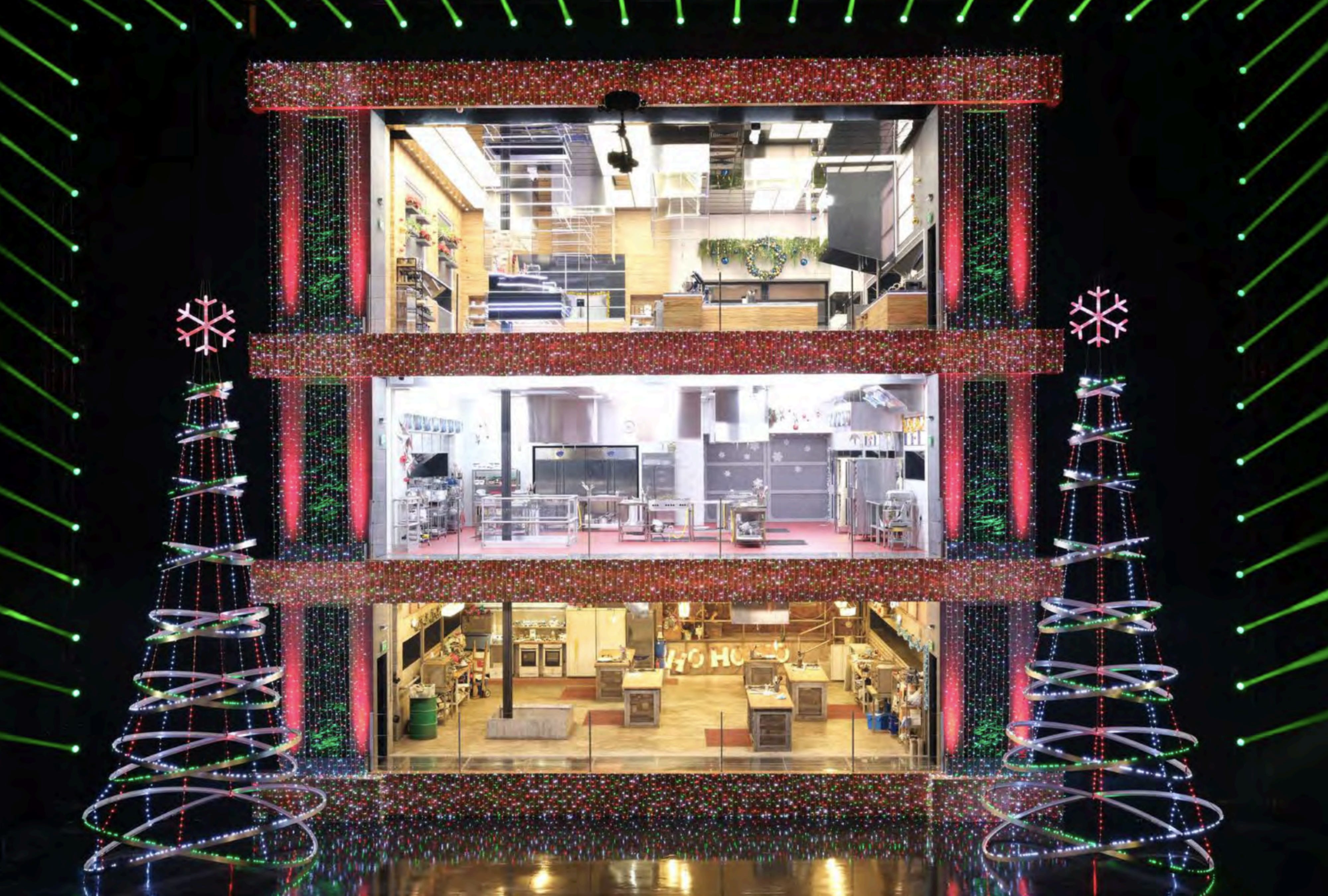
The top kitchen, what some call the “French Laundry” kitchen, is a luxury baking kitchen, filled with top-of-the-line equipment, every culinary tool imaginable, and a well-stocked pantry. It’s comparable to a professional, high-end kitchen. The middle kitchen is working and functional, and it’s provisioned with standard kitchen equipment. But there are no frills and the cabinets are bereft of fancy cooking utensils. Then there’s the basement level, which you might call bare bones. The equipment is basically in working order but shoddy; cooking tools are minimal, cupboards are bare, and overall it’s a challenging environment in which to bake.
Unfair, right? There’s more.
The producers didn’t stop at building different kitchens. There’s also the giant platform that moves through the three kitchens, piled high with ingredients, ranging in quality and sophistication. For a challenge involving ginger, for example, there’s fresh ginger, candied stem ginger, powdered ginger, pickled ginger, and ginger ale. For a chocolate challenge, there’s premium dark chocolate in bars but there’s also a bottle of chocolate syrup. The platform starts in the upper kitchen, where the bakers have 30 seconds to grab what they want. Then the platform descends to the middle kitchen, where the bakers on that level do the same. Then it goes to the basement, where the bakers take whatever’s left and hope it’s not too terrible.
Since it’s a holiday baking show, all three levels are festooned with decorations, lights, carolers, ice skaters, and even a children’s choir. So there’s that. But you might be thinking there are some lessons to be gleaned from the show. Correct.


Thoughts so far? Favorite baking shows? Have you watched Next Level Baker?
One of the most obvious lessons that Next Level Baker teaches us is that place matters. The right kitchen matters not only because it gives you an abundance of expensive equipment but also access to the premium ingredients. In the same way, neighborhoods matter, school zones matter, and zip codes matter. Significant research has proved the connection between place and the horizon of possibility, especially for children. Raj Chetty and his team of researchers created the Opportunity Atlas to reveal and track these connections between geography, local resources, and individual and well as family outcomes. Geography has an impact on educational attainment, credit access, health outcomes, and economic success. Geography, as some have said, is a form of destiny.
Another clear lesson that Next Level Baker imparts is that chance determines your starting point. In the first episode, what kitchen the bakers will be creating their holiday delights in is determined through random selection. Everything that the upper kitchen has to offer is available to a select set of bakers purely by virtue of a lucky pick. That’s inheritance for you - the abundance or absence of generational wealth is sheer luck, based on neither talent nor labor. As I wrote in last week’s post, the philosopher Robert Nozick, said that inheritance “sticks out as a special kind of unearned benefit.” Just like starting in the upper kitchen.
There’s a pointedly hopeful lesson that is deliberately thrown into the mix as well, that mobility between the kitchens is possible. Somewhat surprisingly, the bakers who started in the top level did not all stay in the upper kitchen, and there’s been some movement between levels. Some bakers have totally flubbed their bakes even with all the resources of the upper kitchen behind them; other bakers have triumphed despite the obstacles presented by the basement kitchen. It’s true, similarly, that social positioning and economic circumstances are subject to change - for better or for worse - based on extraordinary performance. But social mobility is declining in the United States as well as globally, and the barriers to mobility are hardening in place.

Kitchen inequality is clearly part of the show’s design- it is a feature, not a bug (another lesson). The take-away is clearly supposed to be the optimistic one, that a baker who gets sorted into the basement level can indeed climb their way out through creativity, persistence, and effort. The official lesson is that hard work and merit can triumph over inherited resources and unearned advantage, a Horatio Alger story with bundt cakes. But I’m still stuck on how strangely honest the show is about the fact that different populations have incredibly different material conditions shaping their outcomes. I’m also unable to ignore that the show is highly reflective of our current politics in that no one thought it was a good idea to give the basement bakers any kind of aid in order to help them overcome a rigged system. They’re on their own in the basement, rusty springform pans and all.
At this point, we don’t know who’s going to win Next Level Baker, but I’m rooting for the basement bakers!
Thanks for reading this far 👏🏻. Please spread the 💚 and subscribe if you haven’t already!
You might also like these:


Holy shit, it’s like The Platform. If you haven’t seen that movie, beware, because it’s brutal: In this prison, each day a sumptuous spread is provided on a platform that moves from the upper levels (where prisoners stuff themselves) down to the bottom levels (where only bones and crumbs are left).
ALSO, I do some pretty serious cooking in a kitchen we built largely by hand, wrestled from free scrap wood. And as someone whose topic is economic inequality, and who often talks about cooking from scratch and baking sourdough from wheat I grind at home, this piece couldn’t be more perfect for me.
The parallels you drew between the show's setup and the economic system setup make this show a must-watch now. Fascinating.
Watching tonight.