
The Family Vacation
How family inequality travels and where it shows up on summer vacation

The family vacation is a hallmark of summertime. Families go to the beach. They visit relatives. They rent a cabin in the mountains, pack the car, drive twelve hours to see other family members. There is an infinite variety of family vacations, but there is one thing they all share in common. Traveling with everybody, no matter what the destination is, are family money, family identity, and family inequality. These characteristics settle in, whether it’s into the pocket of the first-class flight to Rome or the glovebox on the road trip to see grandparents. Family structures don’t stay at home with the cat.1
This August, in honor of summer vacation, Inheriting Inequality is turning its focus to leisure and how it intersects with families and their money. The month’s theme starts today with a post on the family vacation and why family sits at the center of the leisure economy on both ends of the wealth spectrum.

Family money, whether you have a little or a lot, determines location.
Whether you are on the high-wealth end of the spectrum or its opposite, family money often determines where you go on summer vacation. For families with money, there are family properties that form a part of family tradition when it comes to vacationing. A compound in Maine, a house in Aspen, real estate in the Cotswolds or the south of France. Vacation takes place in trust-held properties, where generations return year after year. This kind of vacation is free and easy, but it also plays a major role in creating family identity and history.
For families without much money to spend on vacation, family properties also determine location. In this case, however, vacation is all about the relative’s couch, the free lodging, the drive to see grandparents and stay with them. This kind of vacation is also free and easy. And it also plays a major role in creating family identity and history. Family and family money are never incidental to vacation, they are the mechanisms that make vacation possible at every income level. It’s just that the view out the window is completely different depending on the family.
Does your vacation depend on wealth accumulation or depletion?
Despite the superficial differences between these two kinds of family vacations - a villa on the Mediterranean versus the waterpark down the street from grandma’s house - both forms can be fantastic. Money certainly does not guarantee a great time, nor does the lack of it necessarily impose any obstacles to having a terrific and memorable vacation. The more meaningful difference is how family money operates underneath the different vacation home facades. The two different kinds of vacations run on two parallel but completely divergent household financing systems.
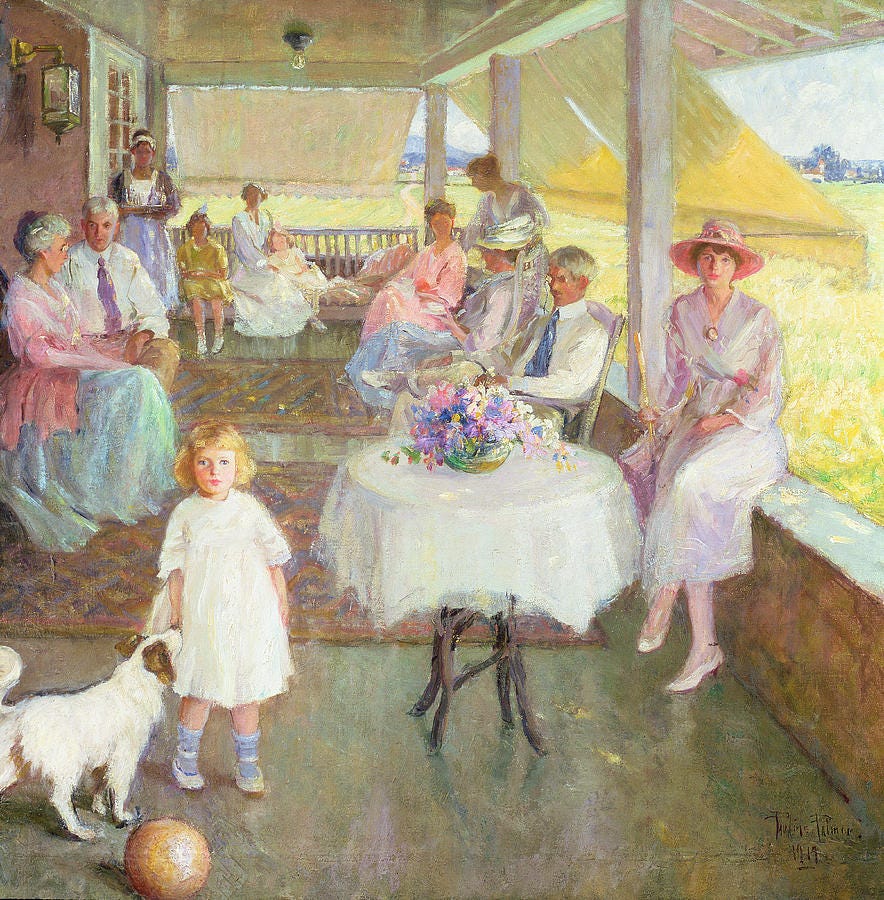
High-wealth vacations run on family money and sit atop the accumulation of it. Vacation homes in trust, gifted property, appreciating real estate, generational capital. These are the building blocks of high-wealth vacations and they don’t require anyone to save up. Instead they let families enjoy assets that are actively building more wealth, through appreciation and tax savings, while the family has breakfast or spends the day by the pool.
Working-class vacations run on family savings: income that has been squirreled away and credit card debt that has been incurred. Vacation planning requires budgeting and a trail of small decisions (where to stop for gas, whether the hotel breakfast is included, what snacks to bring in the car). Vacation is never done on the back of accumulating wealth; instead vacation depletes family wealth and may even add new debt.2 This difference gets at a key function of the leisure class: they can afford time away because their assets work for them. They own capital instead of working for it.
Family vacation reveals other forms of inequality too.
The family vacation provide a window into unequal access to leisure and economic opportunities. In this respect, summer travel reveals how inequality between families plays out away from home. Family vacation also provides a window into other, related forms of inequality that inhere in the family structure, relating to who does the work to make family vacation possible.
On the high-wealth end, family vacation is often made possible by the labor of other families, the ones who live locally and get paid to ensure that the upscale family vacation goes smoothly. The nannies who are hired for childcare, the cleaning staff who keep the homes spotless, the landscapers who tend to the grounds, and the caterers who put together picnic baskets and cocktail parties. In this way, family vacation highlights the vastly varying economic vistas that can be found at different locations on the wealth spectrum. Vacation for some is labor for others, and historical patterns with respect to class, race, and gender repeat themselves.

For example, on the other end of the wealth spectrum, the work of family vacation - the care work and household labor done by professional staff in the high-wealth context - often falls to women in the family. Women do the majority of the vacation planning, meal preparation, and childcare during travel. Similarly, they do unpaid hosting, cooking for guests, and childcare when visitors come to their houses. All the things that make these road trips and visits to the relatives successful are done without compensation, which heightens intra-family inequality.

Moreover, this kind of gender inequality on summer vacation is not limited to families at one point on the wealth spectrum. Gender-coded roles and hierarchies pertain in the high-wealth world as well. Women are typically the ones who book the plane tickets and make restaurant reservations. They are the ones who manage the staff, and make sure that activities are planned. Amplifying the inequality in these high-wealth scenarios, while the women are often the ones doing the managing and administrative work of family vacation, they are less frequently the ones listed on the property deed or the inheritance documents. Unpaid labor is accompanied by the unequal distribution of family assets.
*****
Vacation doesn’t escape the inequalities of ordinary life. It just relocates them to a lovelier landscape: a beach, a mountain, an island reachable only by ferry. The hierarchy inside the family, who holds the deed and who does the dishes, and the hierarchy between families, who vacations and who serves, are the same. The architecture of family inequality doesn’t change. Ultimately, that may be the clearest thing family vacation tells us about family money: not how much a family has, but who inside and around that family is allowed to actually stop working while everyone else calls it summer.
What does summer vacation bring up for you? Any memorable vacations or memories of vacation being a lot more work than it should have been?
My upcoming book, The House That Family Money Built (UC Press, September 2026), offers a deep dive into how legal architecture protects dynastic wealth and extracts from low-income families along the same lines it always has: race, gender, and class. You can pre-order the book here (or click on the book cover) and don’t forget to subscribe to Inheriting Inequality to get the latest posts!

Anne Helen Petersen had a great post last year about how people remember their family vacations. Great insights and memories here.
For more on how people are currently financing vacations, check out Heather and Douglas Boneparth’s latest post on How to plan a vacation.
Mostly, the bottom half of Americans don’t vacation at all, or maybe once or twice.
The only vacation I took my kids on when they were young was a trip to visit relatives in another state. We once managed an overnight to Chicago and another to St. Louis.
When I remarried, we took them to Europe to visit my husband’s Dutch family, but that was after my daughter had graduated from high school.
I really wanted to give them real vacations but it was impossible.
Throughout my life, my father complained viciously about his childhood summer vacations, which were taken by paneled station wagon, five children in tow. He always said it was because the family was so poor.* I’ve just realized, thanks to your inclusion of the Rockwell, that summer station wagon adventures were probably my grandmother’s idea of true wealth. My dad was born in 1948 and my grandmother absolutely ADORED Rockwell. She even wore a headscarf like the mom on the painting! Thanks for the lovely reframe of my family history. :)
*My grandfather was the director of the Chicago Arboretum, hence my skeptical tone.